
The Fire Skink is a striking African lizard known for its glossy red, orange, bronze, black, and sometimes gold-toned coloration. However, its appearance is only part of the appeal.
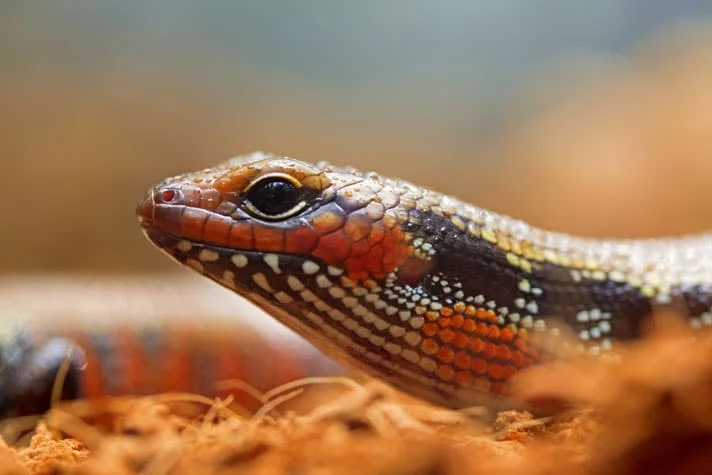 These secretive, ground-dwelling reptiles are fascinating to watch as they burrow, explore, bask, hunt insects, and move through a well-designed tropical enclosure.
With the right environment, diet, lighting, humidity, and routine care, a Fire Skink can become a rewarding long-term pet. At the same time, this species has specific needs, so learning about Fire Skink care before bringing one home is essential.
Fire Skink Quick Facts
Fire Skinks are terrestrial, primarily daytime-active lizards that naturally spend much of their time close to the forest floor. They are strong burrowers and often use leaf litter, soil, roots, fallen vegetation, and other natural cover for protection.
| Care Requirement | Recommended Information |
| Scientific name | Mochlus fernandi |
| Common names | Fire Skink, African Fire Skink |
| Adult size | Approximately 12–15 inches |
| Difficulty | Moderate / Intermediate |
| Activity | Primarily diurnal |
| Lifestyle | Terrestrial and burrowing |
| Main diet | Insects and other invertebrates |
| Adult enclosure | At least about 36 × 18 × 18 inches |
| Basking area | Approximately 92–96°F |
| Cool area | Approximately 75–85°F |
| Average humidity | Around 60–70% |
| Night temperature | Around 70–75°F |
| Substrate depth | Around 4–6 inches |
| Potential lifespan | Around 15–20 years |
| Social needs | Usually best kept individually |
These figures are useful starting points, but they should not replace actual monitoring. Every enclosure behaves differently, so digital thermometers and hygrometers are valuable tools.
What Is a Fire Skink?
A Fire Skink is a medium-sized terrestrial skink native to parts of Africa. Its scientific name is generally recognized as Mochlus fernandi.
Older reptile literature and some online resources may use different scientific names, which can make research confusing for new keepers. The species is famous for its spectacular coloration.
Depending on the individual, the body may display deep red, orange, bronze, brown, black, and white markings. Their scales can have a glossy appearance that becomes especially noticeable under appropriate lighting.
Despite their dramatic appearance, Fire Skinks are not naturally attention-seeking animals. Instead, they tend to rely on cover and camouflage. They may spend substantial periods hidden beneath substrate, leaves, logs, or other enclosure furnishings.
That behavior is normal. A Fire Skink that occasionally disappears into its burrow is not necessarily unhealthy. In fact, providing enough opportunities to hide is an important part of good husbandry.
Origin and Where Do Fire Skinks Live?
The African Fire Skink is associated with humid forest and forest-edge environments in parts of western and west-central Africa. Its natural environment is important because it gives us clues about how the species should be kept in captivity.
Rather than living in dry, open desert-like habitats, Fire Skinks are adapted to environments where moisture, vegetation, soil, leaf litter, and shaded areas are available.
Their natural lifestyle helps explain several captive-care requirements:
- Deep substrate supports burrowing.
- Moisture-retentive substrate helps maintain humidity.
- Vegetation creates cover.
- Fallen logs and roots provide hiding places.
- A temperature gradient allows thermoregulation.
- Invertebrate prey supports their natural feeding behavior.
- Daytime lighting supports their activity pattern.
Therefore, a successful enclosure should imitate the structure and environmental variety of the forest floor rather than simply trying to achieve one temperature and one humidity reading.
Skink Habitat and Natural Behavior
Fire Skinks are terrestrial reptiles, which means they spend most of their lives on the ground rather than climbing high into trees. They are also excellent burrowers.
In captivity, this means your skink may spend time digging beneath the substrate, disappearing under leaf litter, or creating small tunnels. A naturalistic habitat can encourage these behaviors.
Consider including:
- Deep substrate
- Cork bark
- Smooth branches
- Hollow logs
- Leaf litter
- Live or artificial plants
- Multiple hides
- Open walking areas
- A moist retreat
- A warm basking location
Furthermore, visual barriers can help a shy animal feel secure. An enclosure that is completely exposed from every direction may make a Fire Skink feel vulnerable.
Adding plants, cork, and foliage can create a more comfortable environment.
Skink Size and Appearance
One of the most frequently searched questions is Fire Skink size.
A healthy adult can reach approximately 12–15 inches (30–38 cm) in total length, although individual size varies. Their body is relatively robust, while their legs are comparatively short and powerful.
This body shape works well for moving through leaf litter and soil. Coloration is one of their strongest characteristics.
Depending on the individual, you may see:
- Bright red sides
- Orange or bronze tones
- Dark dorsal markings
- Black patterns
- White or cream details
- Metallic-looking scales
This is why terms such as red Fire Skink, true Fire Skink, and fire red skink are sometimes used by reptile keepers and sellers.
However, these terms generally describe appearance or hobby terminology rather than automatically identifying separate species.
Fire Skink Tank Size and Enclosure
Choosing the correct Fire Skink tank size is one of the most important decisions you will make. For one adult, a commonly recommended minimum is approximately 36 × 18 × 18 inches.
However, larger is preferable whenever you have the room and budget for it.
A larger enclosure makes it easier to create:
- A proper basking zone
- A cooler retreat
- Deep substrate
- Multiple hides
- Natural cover
- Feeding areas
- Exploration routes
- A stable humidity gradient
Floor space is especially important because Fire Skinks are terrestrial.
Height can still be useful, particularly for enrichment and enclosure furnishings, but excessive height should not come at the expense of usable floor area.
What Should a Fire Skink Enclosure Include?
A well-planned Fire Skink enclosure should contain:
- Secure enclosure with reliable ventilation
- Deep, burrow-friendly substrate
- Warm basking area
- Cooler zone
- Several hides
- Suitable UVB
- Appropriate heating
- Digital thermometers
- Digital hygrometer
- Stable water bowl
- Natural or reptile-safe decorations
- Leaf litter
- Safe plants
- Climbing and exploration structures close to the ground
Most importantly, avoid filling the enclosure with so many decorations that the animal cannot move comfortably. The goal is complexity without clutter.
Skink Substrate and Burrowing
Substrate is one of the most important parts of Fire Skink husbandry because burrowing is a natural behavior.
A substrate that is too shallow, excessively dry, sharp, or compacted can prevent the animal from behaving naturally.
A depth of around 4–6 inches is a useful starting point for an adult setup, although a deeper substrate area can provide even more opportunities for digging.
A suitable tropical substrate should:
- Retain moderate moisture
- Allow digging
- Be free from pesticides
- Avoid sharp particles
- Avoid artificial fragrances
- Not contain dangerous additives
- Remain structurally suitable for burrowing
A soil-based tropical mixture can work when prepared from reptile-safe materials.
The substrate should feel appropriately moist without becoming permanently waterlogged. That distinction is important. High humidity does not mean a constantly soaked enclosure.
Fire Skink Temperature and Heat
Correct temperatures allow reptiles to regulate their body temperature naturally.
For a Fire Skink, a useful starting range is:
| Enclosure Zone | Approximate Temperature |
| Basking area | 92–96°F |
| Warm zone | Around 80–90°F |
| Cool zone | 75–85°F |
| Night | Around 70–75°F |
A temperature gradient is much better than heating the entire enclosure to one identical temperature. Your skink should be able to choose where it wants to spend time.
For example, it may bask briefly and then retreat into a cooler hide. Later, it might explore the substrate or move back toward the warm zone. Use digital probe thermometers to measure different areas.
Also, heat sources should be safely secured and controlled to reduce the risk of burns or overheating.
Fire Skink Humidity Requirements
Humidity is another essential part of fire skinks’ care.
A commonly recommended average humidity range is approximately 60–70%, with appropriate ventilation and moisture-retentive substrate.
Rather than chasing one exact number all day, focus on creating a stable environment with natural variation.
Helpful methods include:
- Moist tropical substrate
- Regular misting
- Leaf litter
- Plants
- A humid hide
- Appropriate water access
- Good ventilation
A hygrometer should be placed where it gives you useful information about the enclosure rather than directly under a misting nozzle.
Furthermore, excessive moisture combined with poor ventilation can create unhealthy enclosure conditions. The goal is humid and well-ventilated, not stagnant.
Fire Skink Diet and Feeding
The Fire Skink diet is primarily based on insects and other suitable invertebrates. A varied menu is preferable to feeding only one type of insect.
Possible feeder options include:
- Crickets
- Dubia roaches
- Discoid roaches
- Mealworms
- Superworms
- Hornworms
- Silkworms
- Earthworms
- Isopods
- Other appropriate captive feeder insects
Feeder insects should be appropriately sized. A useful rule is to avoid offering prey that is excessively large for the animal to manage comfortably.
How Often Should a Fire Skink Eat?
Feeding frequency depends on age and body condition.
Generally:
- Young Fire Skinks need more frequent feeding.
- Juveniles may eat daily or every other day.
- Adults usually require fewer feeding sessions.
- Individual appetite can vary.
- Body condition should be monitored over time.
ReptiFiles recommends daily-to-every-other-day feeding for juveniles and approximately twice-weekly feeding for adults, while emphasizing appropriately sized prey.
Instead of forcing an animal to finish a predetermined number of insects, pay attention to its appetite, activity, growth, and body condition.
Fire Skink Water Requirements
Fresh, clean water should be available at all times. A shallow, stable bowl works well. The dish should be easy to access and difficult to tip over.
Check it regularly because substrate, insects, leaves, and feces can contaminate water quickly.
Even if you mist the enclosure regularly, do not assume misting alone replaces a clean drinking-water source.
Fire Skink Lifespan
The potential Fire Skink lifespan is one reason this species should be considered a serious long-term commitment.
With appropriate husbandry, captive Fire Skinks may live approximately 15–20 years. That means purchasing one is not a short-term decision.
Before bringing one home, consider whether you can provide:
- Proper food for many years
- Replacement UVB bulbs
- Heating equipment
- Substrate
- Supplements
- Veterinary care
- A suitable enclosure
- Emergency funds
- Long-term daily care
A beautiful juvenile may look like an easy pet, but the real commitment becomes clearer when you consider two decades of responsible ownership.
Fire Skink Temperament and Handling
Fire Skinks have individual personalities, but many are naturally shy and cautious. Some captive-bred animals become much calmer with patient care.
However, this does not mean every Fire Skink will enjoy being handled.
They are often:
- Fast
- Alert
- Secretive
- Defensive when frightened
- Curious when comfortable
- More interested in exploring than sitting still
For that reason, they are usually better suited to people who enjoy watching reptile behavior.
How to Tame a Fire Skink
Start slowly.
During the first days after bringing the animal home, allow it to settle without unnecessary disturbance.
Then:
- Sit near the enclosure.
- Move slowly around the animal.
- Allow it to see your hand without chasing it.
- Offer food with appropriate feeding tongs.
- Gradually introduce brief interaction.
- Stop if the animal shows strong signs of stress.
- Never grab a frightened skink from above unless necessary for safety or veterinary care.
Patience is more effective than force.
Are Fire Skinks Good Pets?
Yes, Fire Skinks can be excellent pets for the right keeper.
They are especially appealing if you enjoy:
- Tropical naturalistic enclosures
- Burrowing reptiles
- Watching hunting behavior
- Observational pets
- Exotic animal husbandry
- Creating bioactive-style habitats
- Long-term reptile keeping
However, they may not be the best choice if your main goal is a reptile that enjoys constant handling. Their personality can also vary between individuals.
Therefore, the better question is not simply “Are Fire Skinks good pets?”
Instead, ask:
Is a shy, burrowing, tropical, long-lived reptile suitable for my lifestyle?
For the right owner, the answer can absolutely be yes.
Baby Fire Skink Care
A baby Fire Skink needs the same basic environmental principles as an adult, but careful monitoring becomes even more important.
Young animals should have:
- Appropriately sized prey
- Reliable access to food
- Suitable humidity
- Correct temperatures
- Appropriate UVB
- Secure hiding places
- Burrow-friendly substrate
- Clean water
Do not keep a baby in an empty enclosure simply because it is small. Instead, provide safe cover and appropriately scaled furnishings.
A young animal may also spend significant time hiding. That behavior can be normal, especially after relocation.
Fire Skink Cleaning and Maintenance
A clean enclosure supports good hygiene, but excessive cleaning can also destroy the natural complexity that makes a habitat interesting. A balanced routine works best.
Daily Checks
Check:
- Water
- Temperature
- Humidity
- Animal behavior
- Food leftovers
- Visible waste
Remove obvious waste and heavily contaminated substrate.
Weekly Maintenance
Depending on your setup:
- Clean the water bowl thoroughly.
- Wipe contaminated surfaces.
- Inspect hides.
- Check plants.
- Inspect heating equipment.
- Check UVB placement.
- Review temperature and humidity readings.
Deep Cleaning
For traditional non-bioactive setups, periodic substrate replacement may be necessary.
The exact frequency depends on enclosure size, substrate type, ventilation, animal number, and spot-cleaning practices. Bioactive enclosures require a different maintenance strategy.
Instead of removing everything frequently, the keeper maintains the biological system while still spot-cleaning waste and monitoring hygiene.
Fire Skink Fun Activities and Enrichment
A Fire Skink will not play fetch or chase a toy around the room.
Nevertheless, enrichment can make its life considerably more interesting. The best enrichment encourages natural behavior.
Burrowing Enrichment
Give your skink enough substrate to dig. You may notice it creating tunnels or disappearing beneath the surface.
Hunting Enrichment
Appropriately sized feeder insects can encourage natural hunting. Offer prey safely and monitor feeding sessions.
Exploration
Use cork bark, leaf litter, plants, logs, and hides to create different routes through the enclosure.
Plant Enrichment
Safe live plants can provide cover and encourage exploration.
Feeding Location Changes
Occasionally changing where you offer food can encourage searching.
However, avoid making the animal work excessively hard for food.
Natural Cover
Leaf litter provides additional hiding and exploration opportunities. The goal is not to make the enclosure constantly different.
Instead, create a habitat where the animal has choices.
Bioactive Fire Skink Enclosure
A bioactive enclosure can be an excellent option for this species because it can combine deep substrate, plants, leaf litter, microorganisms, and naturalistic furnishings.
A properly established bioactive setup may contain:
- Soil-based substrate
- Leaf litter
- Live plants
- Springtails
- Isopods
- Cork bark
- Hides
- Drainage considerations where appropriate
- Proper ventilation
The cleanup crew can help break down organic waste, but it does not eliminate the need for human maintenance.
You still need to monitor:
- Humidity
- Temperature
- Mold
- Waste
- Plant health
- Substrate condition
- Animal health
A bioactive enclosure should never be treated as a “self-cleaning tank.”
Fire Skink Shedding
Like other lizards, Fire Skinks periodically shed their skin as they grow.
During shedding, you may notice:
- Duller coloration
- Increased hiding
- Loose skin
- Reduced activity
- Changes in appetite
Good humidity and hydration can support normal shedding.
Never pull off attached skin. Instead, maintain suitable environmental conditions and allow the animal to complete the process naturally.
If retained skin repeatedly occurs around toes, eyes, or other sensitive areas, seek veterinary advice.
Common Fire Skink Care Mistakes
Even well-intentioned keepers can make mistakes. Avoid these common problems:
1. Keeping the Enclosure Too Small
Small tanks limit movement and make proper environmental gradients harder to create.
2. Using Very Shallow Substrate
Fire Skinks are natural burrowers, so substrate depth matters.
3. Keeping Everything Permanently Wet
Humidity is important, but stagnant, waterlogged conditions are not the goal.
4. Ignoring Ventilation
High humidity and poor airflow can create unhealthy conditions.
5. Feeding Only One Type of Insect
Variety is generally better for nutritional diversity.
6. Handling Too Frequently
Forced interaction can increase stress.
7. Providing Only One Hide
Multiple hiding opportunities give the animal more control over where it feels secure.
8. Guessing Temperatures
Always measure temperatures instead of relying on how warm the enclosure feels to your hand.
9. Buying the Animal Before Preparing the Enclosure
Set up and test the habitat first.
10. Choosing a Fire Skink Based Only on Appearance
Beautiful coloration should never be the only reason to buy an exotic pet.
Fire Skink Price and Ownership Cost
The Fire Skink price varies depending on factors such as age, breeder, captive-bred status, coloration, location, availability, and seller reputation.
However, the purchase price is only the beginning.
A realistic ownership budget should include:
| Expense | What to Consider |
| Fire Skink | Age, health, breeder, availability |
| Enclosure | Size and quality |
| Heating | Heat source and thermostat |
| UVB | Fixture and replacement bulbs |
| Substrate | Initial and recurring costs |
| Food | Ongoing feeder insects |
| Supplements | Calcium and vitamins |
| Decorations | Hides, cork, plants, leaf litter |
| Monitoring | Thermometers and hygrometer |
| Veterinary care | Routine and emergency expenses |
Therefore, someone searching for a Fire Skink for sale should calculate the complete setup cost rather than budgeting only for the reptile.
Fire Skink for Sale: What to Look For
Searching for fire skink for sale, fire skinks for sale, African Fire Skink for sale, or even skinks for sale can produce many sellers.
However, the cheapest listing is not automatically the best choice.
When evaluating a breeder or seller, ask:
- Is the animal captive-bred?
- How old is it?
- Is it eating consistently?
- What food has it been eating?
- What temperatures has it been kept at?
- What humidity has it experienced?
- Has it had any health problems?
- Can the seller provide a feeding history?
- Can they explain its care requirements?
- Do they appear knowledgeable about the species?
Signs of a Responsible Seller
A responsible seller should be willing to discuss the animal’s care rather than simply trying to complete a sale.
They should also be transparent about:
- Age
- Feeding
- Origin
- Health
- Husbandry
- Sex, if reliably determined
- Shipping or collection conditions
Whenever possible, choosing a healthy captive-bred animal from a reputable source is preferable to purchasing an animal with an unknown history.
Also, check your local laws before acquiring an exotic reptile.
Fire Skink Types and Common Names
Online searches can make Fire Skink terminology confusing.
The following table separates commonly searched terms from the standard species name.
| Search Term | Meaning / Context |
| Fire Skink | Common name associated with Mochlus fernandi |
| African Fire Skink | Common name emphasizing its African origin |
| True Fire Skink | Informal hobby term |
| Red Fire Skink | Usually a color-based description |
| Fire Red Skink | Informal color/search variation |
| African Fire Skink size | Search phrase about adult dimensions |
| African Fire Skink care | Search phrase about husbandry |
| Baby Fire Skink | Young Fire Skink |
| Fire Skinks | Plural form |
| Fire Belly Skink | Search term that can cause species confusion |
| Fire Tailed Skink | Informal/misleading search phrase in some contexts |
| Firetail Skink | Informal search variation |
These terms should not automatically be interpreted as separate Fire Skink species.
In particular, color descriptions such as “red” do not necessarily indicate a scientifically distinct variety.
Fire Skink Breeding Basics
Breeding Fire Skinks is possible, but it should not be approached casually.
Before attempting breeding, the keeper should already understand:
- Sex identification
- Adult health
- Nutrition
- Appropriate temperatures
- Seasonal behavior
- Egg-laying requirements
- Incubation
- Hatchling care
- Housing
- Feeding young reptiles
- Potential veterinary complications
Breeding should never be used as a reason to purchase multiple animals without a realistic plan for their offspring.
Furthermore, responsible breeding means having a plan for every baby before breeding begins.
A Simple Fire Skink Daily Care Routine
A predictable routine makes care easier.
Morning Check:
- Basking temperature
- Cool-side temperature
- Humidity
- Water
- Animal appearance
- Heating and lighting equipment
If needed, mist according to your enclosure’s humidity pattern.
During the Day
Allow your Fire Skink to explore, bask, burrow, and hide naturally.
Avoid unnecessary disturbance.
Evening
Check:
- Water
- Waste
- Food leftovers
- Humidity
- Substrate condition
If your enclosure requires evening misting, adjust the routine based on measured humidity rather than guessing.
Weekly
Perform a more detailed inspection of:
- Equipment
- Hides
- Plants
- Substrate
- Water dish
- Heating setup
- UVB placement
Fire Skink Care Checklist for Beginners
Before bringing home your first Fire Skink, make sure you have:
- Properly sized enclosure
- Deep substrate
- Secure hides
- Basking heat source
- Thermostat
- UVB lighting
- Digital thermometers
- Hygrometer
- Water bowl
- Appropriate feeder insects
- Calcium and suitable supplements
- Safe decorations
- Leaf litter
- Cleaning supplies
- Emergency veterinary plan
- Knowledge of local ownership laws
Most importantly, test the enclosure before the animal arrives.
This allows you to discover temperature or humidity problems while the enclosure is still empty.
FAQs
1. Are Fire Skinks good pets?
Yes. Fire Skinks can be rewarding pets for owners who enjoy observing natural reptile behavior and maintaining a tropical enclosure. They are less ideal for people looking for a reptile that enjoys frequent handling.
2. How big does a Fire Skink get?
An adult Fire Skink commonly reaches approximately 12–15 inches in total length, although individual size can vary.
3. What is the best Fire Skink tank size?
A commonly recommended minimum for one adult is approximately 36 × 18 × 18 inches. A larger enclosure is preferable when practical because it provides more room for deep substrate, hides, plants, and temperature gradients.
4. What does a Fire Skink eat?
Fire Skinks are primarily insectivorous. Their diet can include crickets, roaches, worms, mealworms, superworms, hornworms, silkworms, and other suitable invertebrates.
5. How often should you feed a Fire Skink?
Young Fire Skinks generally require more frequent feeding than adults. Juveniles may be fed daily or every other day, while adults are commonly fed fewer times per week depending on body condition and prey size.
6. What humidity does a Fire Skink need?
A commonly recommended average is approximately 60–70%, combined with moisture-retentive substrate and good ventilation.
7. How long do Fire Skinks live?
A properly cared-for Fire Skink may live approximately 15–20 years, making it a substantial long-term commitment.
8. Are Fire Skinks poisonous?
No. Fire Skinks are not poisonous or venomous reptiles. Their bright coloration is not an indication that they possess venom.
9. Can Fire Skinks be handled?
Some individuals can become accustomed to gentle handling, particularly when captive-bred and patiently socialized. However, many are naturally shy and are better suited to observation than frequent handling.
10. Do Fire Skinks need UVB?
Providing appropriate UVB is generally recommended as part of a comprehensive daytime lighting setup. The correct bulb and placement depend on enclosure design and manufacturer specifications.
Final Thoughts
The Fire Skink is an impressive reptile, but its appeal goes beyond its beautiful colors.
Its burrowing behavior, insect-hunting instincts, secretive personality, and tropical habitat requirements make it an especially interesting species for keepers who enjoy naturalistic reptile husbandry.
The foundation of successful Fire Skink care is consistency. Provide enough floor space, deep moisture-retentive substrate, appropriate temperatures, suitable humidity, UVB, varied feeder insects, clean water, secure hiding places, and meaningful environmental enrichment.
At the same time, allow the animal to behave naturally rather than expecting it to become a constantly handled pet. For someone who wants a reptile to observe, a Fire Skink can be an excellent choice.
However, responsible ownership starts before the purchase. Prepare the enclosure first, understand the long-term financial commitment, locate an exotic-animal veterinarian, research local regulations, and choose a healthy animal from a reputable source.
I’ve created helpful guides in the Birds category on Petstdigo, featuring posts in Care, Cleaning, and Fun Activities. These guides share practical tips on grooming, skin and coat health, bathing routines, nutrition, playtime ideas, and calming solutions to keep your pets happy and healthy. Explore these pages for easy-to-follow advice and insights to support your pet’s overall well-being.