
The Monkey-Tailed Skink is one of the most unusual pet lizards in the world. Also called the prehensile-tailed skink or Solomon Islands skink, this large arboreal reptile is famous for its strong gripping tail, tree-dwelling lifestyle, and mostly plant-based diet.
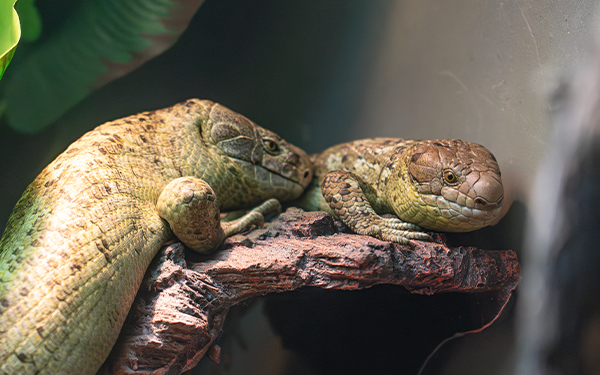 A full-grown Monkey-Tailed Skink can reach around 28 inches (72 cm) in total length and may live for 15–25 years in captivity. Unlike many small pet lizards, this species needs considerable space, climbing opportunities, humidity, UVB lighting, and a carefully planned diet.
Therefore, Monkey-Tailed Skink care is best suited to experienced reptile keepers who can provide a large, secure, tropical enclosure for many years.
If you are researching the Monkey-Tailed Skink as a pet, this guide covers its size, habitat, enclosure, diet, lifespan, temperament, cleaning routine, health needs, price considerations, and important buying tips.
Monkey-Tailed Skink Care Basics
Good Monkey-Tailed Skink care starts with understanding how this lizard lives naturally. It is an arboreal species that spends much of its life above the ground in rainforest vegetation.
Its prehensile tail helps it grip branches, while its strong claws provide additional support when climbing. This is also one of the largest living skinks. The species belongs to the genus Corucia, with the scientific name Corucia zebrata.
CITES lists Corucia zebrata in Appendix II, so responsible ownership and legal sourcing are especially important.
Quick Monkey-Tailed Skink Facts
| Feature | Details |
| Scientific name | Corucia zebrata |
| Common names | Monkey-Tailed Skink, Prehensile-Tailed Skink, Solomon Islands Skink |
| Type | Arboreal lizard |
| Family | Scincidae |
| Adult size | Up to about 28 inches / 72 cm |
| Diet | Primarily herbivorous |
| Lifespan | About 15–25 years in captivity |
| Activity | Mainly nocturnal and crepuscular |
| Native region | Solomon Islands and nearby areas |
| Humidity | High humidity with good ventilation |
| UVB | Recommended |
| Social behavior | Can live in family groups but may be territorial |
| Reproduction | Live-bearing |
| CITES | Appendix II |
Because this species is long-lived and requires specialized husbandry, buying one should never be an impulse decision.
What Is a Monkey-Tailed Skink?
The Monkey-Tailed Skink is a large, heavy-bodied tree-dwelling lizard with a distinctive prehensile tail. The tail works almost like an additional limb, allowing the animal to grip branches while climbing.
Its body is usually dark brown, black, greenish, or grayish with lighter markings. It has a broad head, overlapping scales, strong claws, and a powerful body adapted for climbing.
One particularly interesting feature is that the tail cannot simply be dropped and regenerated like the tails of some other lizards. Because the tail is an important climbing tool, protecting it from injury is especially important.
The nickname monkey skink comes from its ability to move through trees while using its tail for support.
Monkey-Tailed Origin and Natural Habitat
Monkey-Tailed Skinks are native to the tropical Solomon Islands region. They are associated with warm, humid rainforest environments and spend much of their time in trees rather than on the ground.
Their natural environment explains almost everything about their captive care.
They are adapted to:
- Warm tropical conditions
- High humidity
- Dense vegetation
- Tree canopies
- Strong climbing surfaces
- Filtered sunlight
- Plenty of leafy vegetation
- Multiple hiding areas
In the wild, they are commonly associated with rainforest trees, including strangler figs.
Therefore, a simple horizontal reptile tank is not an appropriate setup. A Monkey-Tailed Skink enclosure should provide substantial climbing space and multiple levels.
Monkey-Tailed Skink Size
The Monkey-Tailed Skink size can be impressive compared with many other pet lizards.
Adults may reach approximately 28 inches (72 cm) from the tip of the snout to the end of the tail.
A young skink will obviously be much smaller, but keepers should plan for the adult size from the beginning.
Adult Size vs Baby Size
| Life stage | General expectation |
| Baby | Small compared with adults |
| Juvenile | Rapidly becomes larger and more active |
| Adult | Can approach 28 inches / 72 cm |
| Full grown | Large-bodied arboreal skink |
Remember that enclosure planning should be based on the animal’s expected adult size rather than its size when purchased.
Monkey-Tailed Skink Lifespan
The Monkey-Tailed Skink lifespan is another reason this reptile requires serious commitment.
Smithsonian’s National Zoo reports an expected captive lifespan of approximately 15–25 years. That means bringing one home can be a commitment for decades.
A long life depends on several factors, including:
- Proper temperatures
- Appropriate humidity
- UVB exposure
- Nutritious food
- Clean drinking water
- Safe enclosure design
- Stress reduction
- Veterinary care
- Good genetics
- Responsible handling
Poor husbandry can shorten a reptile’s life, while a carefully maintained environment can support long-term health.
Monkey-Tailed Enclosure Size and Setup
The Monkey-Tailed Skink enclosure size is one of the most important parts of successful husbandry. There is no single universal enclosure dimension that fits every adult because custom builds vary.
However, this species needs a large, secure, highly vertical enclosure with enough room for climbing, resting, feeding, and moving between warm and cool areas.
A tall custom enclosure is generally more appropriate than a standard aquarium.
Recommended Enclosure Features
A good Monkey-Tailed Skink enclosure should include:
- Strong climbing branches
- Thick horizontal and diagonal limbs
- Elevated platforms
- Cork bark
- Hollow logs or sheltered areas
- Dense foliage
- Multiple hiding places
- Secure doors
- Good ventilation
- Waterproof construction
- Safe lighting fixtures
- A large water bowl
- Feeding platforms
The enclosure must also be strong enough to support a heavy adult skink.
Vertical Space Matters
Because this is an arboreal species, height is extremely valuable. Instead of filling the enclosure with only floor substrate, create several usable levels.
For example:
Bottom level: Cool retreat, substrate, water, and some vegetation.
Middle level: Feeding platform, branches, climbing routes, and additional hiding areas.
Upper level: UVB access, basking area, branches, and resting platforms.
This gives the animal choices instead of forcing it to remain at one temperature.
Monkey-Tailed Temperature and Humidity
Temperature management should create a gradient, not a single temperature throughout the enclosure.
A current husbandry guide recommends approximately 24–28°C for the ambient daytime area, a warmer branch around 30–34°C, a cooler shaded retreat around 22–25°C, and nighttime temperatures around 20–24°C.
Temperature Guide
| Area | Approximate range |
| General daytime area | 24–28°C |
| Warm branch | 30–34°C |
| Cool retreat | 22–25°C |
| Night | 20–24°C |
Use reliable digital thermometers at different heights.
Do not assume that the temperature near the bottom is the same as the temperature near the canopy. A thermostatically controlled overhead heat source is preferable to uncontrolled heating.
Hot rocks and similar heat sources can create dangerous localized temperatures.
Humidity
Humidity is equally important. A practical target is generally around 60–80%, with temporary increases after misting and during shedding.
Good ventilation is essential because high humidity without air movement can encourage health problems. The goal is not to keep the enclosure constantly wet.
Instead:
- Mist appropriately.
- Allow surfaces to partly dry.
- Maintain humid air.
- Keep good cross-ventilation.
- Avoid permanently waterlogged substrate.
UVB and Lighting for a Monkey-Tailed
A quality UVB system should be part of a well-designed setup.
Herpeton Academy recommends bright broad-spectrum lighting with a linear T5 UVB lamp positioned over part of the canopy, allowing the animal to move between UV-exposed and shaded areas.
A good lighting arrangement should provide:
- UVB exposure
- Bright daytime light
- Shaded areas
- A normal day/night cycle
- Safe mounting
- No access to chew or climb onto hot fixtures
A photoperiod of roughly 11–13 hours can be used as a starting point, depending on the overall setup and seasonal husbandry plan. Never leave bright visible lighting on throughout the night.
Monkey-Tailed Skink Diet
The Monkey-Tailed Skink diet is primarily plant-based. This is an important difference from many other pet lizards. Their natural feeding behavior is closely associated with leaves and other plant material.
Smithsonian describes them as mostly vegetarian, while current husbandry guidance recommends a browse-led diet with fresh leaves and other plant foods.
Good Food Choices
A varied diet may include:
- Safe pesticide-free leaves
- Mulberry leaves
- Hibiscus leaves and flowers
- Dandelion
- Endive
- Escarole
- Mustard greens
- Turnip greens
- Dark leafy greens
- Squash
- Green beans
- Bell peppers
- Other appropriate vegetables
- Small amounts of suitable fruit
Fresh browse should be a major part of the diet whenever safe and practical.
Herpeton Academy recommends fresh browse as roughly 50–75% of each feeding, with commercial greens used more sparingly and fruit kept as a smaller component.
Safe Food vs Foods to Limit
| Food category | Recommendation |
| Fresh safe browse | Excellent |
| Dark leafy greens | Excellent |
| Safe flowers | Good |
| Vegetables | Good variety |
| Fruit | Limited |
| Very sugary foods | Avoid as a staple |
| Processed human food | Avoid |
| Inappropriate toxic plants | Never feed |
| Unverified pesticide-treated plants | Avoid |
Variety is important because relying on one vegetable or one type of green can create an unbalanced diet.
How Often Should a Monkey-Tailed Skink Eat?
Feeding frequency should depend on age, body condition, activity, and the actual foods offered.
Adults can generally be offered appropriately sized plant foods on a regular schedule, while younger animals may require more frequent access to suitable food.
A simple routine is:
Morning: Check temperature, humidity, water, and enclosure condition.
Feeding time: Offer fresh leafy foods and browse.
Later in the day: Remove wilted or spoiled food.
Daily: Replace dirty food and provide fresh water.
Avoid leaving decomposing food inside a warm, humid enclosure.
Water Requirements
Fresh water should always be available. Use a sturdy bowl that cannot easily tip over when the skink climbs nearby.
Because Monkey-Tailed Skinks are strong animals, lightweight plastic dishes may not always be the best choice.
Change the water regularly and clean the bowl whenever it becomes contaminated. Some animals may also drink droplets from leaves after misting, but this should not replace access to clean drinking water.
Is a Monkey-Tailed Skink a Good Pet?
A Monkey-Tailed Skink can be a fascinating pet, but it is not an ideal choice for everyone.
It may be suitable for an experienced keeper who:
- Understands reptile husbandry
- Has enough space for a large enclosure
- Can maintain humidity
- Can provide UVB
- Can afford specialized equipment
- Understands its long lifespan
- Can provide a proper herbivorous diet
- Is comfortable with limited handling
- Can locate appropriate veterinary care
It may not be suitable for someone looking for:
- A small lizard
- A cheap reptile
- A beginner pet
- A pet that enjoys frequent handling
- A simple aquarium setup
- A low-maintenance animal
The Smithsonian also emphasizes that exotic animals do not always make great pets and that many require specialized care and long-term commitment.
Monkey-Tailed Skink Temperament and Handling
Monkey-Tailed Skinks are intelligent, powerful, and physically adapted for climbing. They are not typically considered a pet reptile that should be handled constantly.
A nervous individual may attempt to escape, scratch, or bite. Their strong claws can cause injuries, while a defensive bite can be painful.
Better Handling Practices
If handling is necessary:
- Wash your hands first.
- Approach slowly.
- Avoid grabbing the tail.
- Support the body.
- Keep the animal close to a safe surface.
- Avoid sudden movements.
- Keep handling sessions short.
- Return the animal if it becomes highly stressed.
For many keepers, observation and interaction through the enclosure are more appropriate than frequent handling.
Social Behavior
Monkey-Tailed Skinks are unusual among reptiles because they can form communal family groups.
Smithsonian describes a social grouping called a circulus, although males and females can also be territorial toward unfamiliar skinks. This does not mean that every individual should automatically be housed with another.
Introducing another animal can create:
- Territorial conflict
- Stress
- Competition for food
- Injury
- Disease transmission
If another skink is introduced, quarantine and careful monitoring are extremely important.
Monkey-Tailed Skink Cleaning Routine
A clean enclosure helps reduce odor, bacteria, parasites, and other health problems.
Daily Cleaning
Remove:
- Uneaten food
- Fresh feces
- Soiled substrate
- Dirty water
- Wet or decomposing plant material
Weekly Checks
Inspect:
- Branches
- Platforms
- Feeding areas
- Water bowl
- Hides
- Substrate
- Ventilation
- Humidity
- Lighting
- Heating equipment
Deep Cleaning
Perform deeper cleaning when needed rather than relying only on surface cleaning.
Make sure cleaning products are appropriate for reptile enclosures and that surfaces are thoroughly rinsed and dried before the animal has access to them.
Because this species requires high humidity, sanitation is especially important.
Enrichment and Fun Activities
A Monkey-Tailed Skink does not need traditional toys. Instead, its enclosure should encourage natural behaviors.
Useful enrichment includes:
- Different branch thicknesses
- New safe browse
- Multiple feeding locations
- Cork bark
- Elevated platforms
- Natural hiding spaces
- Safe foliage
- Different climbing routes
- Visual barriers
- Multiple resting locations
You can occasionally rearrange some nonessential enrichment items, but avoid constantly changing the entire enclosure. A stable environment helps reduce stress.
Monkey-Tailed Skink Health Problems
A healthy skink should have:
- Clear eyes
- Good body condition
- Normal movement
- Strong grip
- Regular appetite
- Healthy skin
- Normal breathing
- Alert behavior during active periods
Warning Signs
Contact an experienced reptile veterinarian if you notice:
| Sign | Possible concern |
| Refusing food for an unusual period | Illness, stress, temperature problem |
| Weight loss | Nutrition or disease |
| Weak grip | Injury, weakness, husbandry problem |
| Open-mouth breathing | Respiratory distress or overheating |
| Nasal discharge | Possible respiratory problem |
| Swelling | Injury or infection |
| Persistent lethargy | Illness or environmental issue |
| Abnormal stool | Digestive or dietary problem |
| Difficulty shedding | Humidity or health issue |
These signs do not diagnose a particular disease. A veterinarian should determine the cause.
Common Monkey-Tailed Skink Care Mistakes
Even experienced reptile keepers can make mistakes with specialized species. Avoid these common problems:
1. Using a Small Enclosure
A baby may look tiny, but it will grow into a large arboreal reptile.
2. Focusing Only on Floor Space
Height and climbing routes are extremely important.
3. Keeping the Enclosure Wet All the Time
High humidity does not mean permanently saturated substrate.
4. Skipping UVB
A properly designed lighting system is an important part of long-term reptile husbandry.
5. Feeding Too Much Fruit
Fruit can be useful, but it should not replace leafy browse.
6. Offering Unsafe Plants
Every plant should be verified before feeding.
7. Handling Too Much
Frequent handling can create unnecessary stress.
8. Ignoring Legal Requirements
This species is listed in CITES Appendix II, so international trade and documentation can be regulated.
9. Buying Without Checking Origin
Do not purchase an animal simply because a seller has a Monkey-Tailed Skink for sale.
Monkey-Tailed Skink for Sale Buying Guide
Searching for a monkey-tailed skink for sale or monkey-tailed skinks for sale can lead to many advertisements, but availability does not automatically mean that an animal is legally or responsibly sourced.
The same applies to searches such as monkey skink for sale and baby monkey-tailed skink for sale.
Before buying, ask the seller:
- Is the animal captive-bred?
- Where did the animal originate?
- Is legal documentation available?
- What is the animal’s approximate age?
- What foods is it currently eating?
- Has it been eating consistently?
- Has it been quarantined?
- Has it been examined by a reptile veterinarian?
- Are there any known health problems?
- What paperwork is required in your location?
CITES lists Corucia zebrata under Appendix II, and historical CITES reviews documented concerns surrounding international trade and population pressure. For that reason, responsible sourcing matters.
Never purchase an animal simply because it is cheap.
Monkey-Tailed Skink Price
The Monkey-Tailed Skink price can vary significantly.
Factors affecting price include:
- Age
- Captive-bred status
- Availability
- Location
- Seller reputation
- Documentation
- Transport
- Veterinary records
- Legal requirements
- Sex
- Overall health
A cheap animal can become extremely expensive if it arrives sick or if you discover that your enclosure is inadequate.
Therefore, calculate the total cost of ownership, not only the purchase price.
Your budget should include:
- Large enclosure
- UVB lighting
- Heating equipment
- Thermostats
- Thermometers
- Hygrometers
- Branches
- Platforms
- Hides
- Substrate
- Plants
- Food
- Supplements if recommended
- Water equipment
- Veterinary care
- Replacement lighting
For an exotic reptile, preparation is often more important than finding the lowest purchase price.
Baby Monkey-Tailed Skink Care
A baby Monkey-Tailed Skink may appear easier to keep because of its smaller size, but the same long-term requirements still matter.
A baby needs:
- Safe climbing opportunities
- Appropriate UVB
- Stable temperatures
- Proper humidity
- Fresh plant-based foods
- Clean water
- Secure hiding areas
- Minimal unnecessary handling
- Careful weight monitoring
Do not place a baby in an unsafe oversized enclosure without making sure it has plenty of accessible hides and secure climbing routes.
The goal is not simply to give it a large enclosure. The goal is to make every part of the enclosure usable and safe.
Monkey-Tailed Skink Breeding and Babies
Monkey-Tailed Skinks are live-bearing reptiles. According to Smithsonian, females carry their young internally for approximately six to eight months.
Single births are most common, although twins can occur. Newborns remain with their family group for several months and may receive protection from adults.
This reproductive strategy makes the species particularly interesting to reptile researchers and experienced keepers. Breeding should not be attempted casually.
A responsible breeding program requires:
- Healthy adults
- Correct identification
- Proper housing
- Genetic awareness
- Veterinary support
- Suitable offspring placement
- Knowledge of legal requirements
Monkey-Tailed Skink Care Checklist
Before bringing one home, make sure you can answer yes to the following:
- Do I have enough space for a large arboreal enclosure?
- Can I maintain appropriate humidity?
- Can I provide UVB?
- Can I create a temperature gradient?
- Can I provide safe climbing branches?
- Can I afford quality equipment?
- Can I provide a varied plant-based diet?
- Can I provide fresh water every day?
- Do I have access to an experienced reptile veterinarian?
- Am I prepared for a 15–25 year commitment?
- Can I verify legal and responsible sourcing?
- Am I comfortable with limited handling?
If several answers are no, this may not be the right reptile for you.
Expert Tips for Better Monkey-Tailed Skink Care
The most important tip is to design the enclosure around the animal’s natural behavior. Instead of thinking only about tank dimensions, think about usable three-dimensional space.
Your skink should be able to:
- Climb
- Hide
- Rest
- Feed
- Drink
- Move toward warmth
- Move toward cooler areas
- Find shade
- Grip secure branches
- Choose different heights
Another important point is to monitor the environment rather than relying on assumptions.
Use accurate instruments and check conditions at different heights. Finally, keep records.
Record:
- Feeding
- Weight
- Shedding
- Behavior
- Temperature
- Humidity
- Veterinary visits
These records can help you recognize changes before they become serious problems.
FAQs
1. How big does a Monkey-Tailed Skink get?
A full-grown Monkey-Tailed Skink can reach approximately 28 inches (72 cm) in total length.
2. How long does a Monkey-Tailed Skink live?
The reported captive lifespan is approximately 15–25 years.
3. Are Monkey-Tailed Skinks good pets for beginners?
Generally, no. Their large size, arboreal enclosure requirements, humidity, UVB, diet, and long lifespan make them better suited to experienced keepers.
4. What does a Monkey-Tailed Skink eat?
They are primarily herbivorous and should receive a varied plant-based diet centered around safe leafy browse, greens, vegetables, and limited fruit.
5. Do Monkey-Tailed Skinks need UVB?
Yes. A properly designed UVB lighting system is recommended as part of responsible captive care.
6. Do Monkey-Tailed Skinks need high humidity?
Yes. They come from humid tropical environments, and captive setups generally require elevated humidity while still maintaining good ventilation.
7. Can Monkey-Tailed Skinks live together?
They can form social groups, but unfamiliar individuals may be territorial. Cohousing should never be automatic and requires careful planning, quarantine, and observation.
8. Are Monkey-Tailed Skinks aggressive?
They are not necessarily aggressive, but they can become defensive when frightened or handled improperly. Their claws and bite can cause injury.
9. Where can I find a Monkey-Tailed Skink for sale?
Look for reputable sources that can demonstrate legal, responsible origin and provide appropriate documentation. Avoid purchasing animals with questionable or unknown provenance.
10. Why is the Monkey-Tailed Skink called a monkey skink?
The nickname comes from its tree-dwelling lifestyle and its ability to use its prehensile tail while moving through branches.
Final Thoughts
The Monkey-Tailed Skink is an extraordinary reptile, but it is not a simple pet. Its impressive size, prehensile tail, climbing ability, plant-based diet, social behavior, and long lifespan make it one of the most fascinating skinks available to experienced keepers.
Successful Monkey-Tailed Skink care depends on creating a spacious arboreal environment with secure climbing structures, suitable temperatures, high humidity, UVB lighting, fresh plant foods, clean water, and plenty of opportunities to hide and move naturally.
If you are considering a monkey-tailed skink for sale, take your time before purchasing.
Research the animal’s legal status, verify its origin, inspect its health, ask about its feeding history, and make sure your enclosure is ready before the skink arrives. Most importantly, remember that keeping an exotic reptile is a long-term responsibility.
A well-prepared keeper does not simply provide a cage—they create an environment where the animal can safely express its natural behaviors for many years.
I’ve created helpful guides in the Birds category on Petstdigo, featuring posts in Care, Cleaning, and Fun Activities. These guides share practical tips on grooming, skin and coat health, bathing routines, nutrition, playtime ideas, and calming solutions to keep your pets happy and healthy. Explore these pages for easy-to-follow advice and insights to support your pet’s overall well-being.