
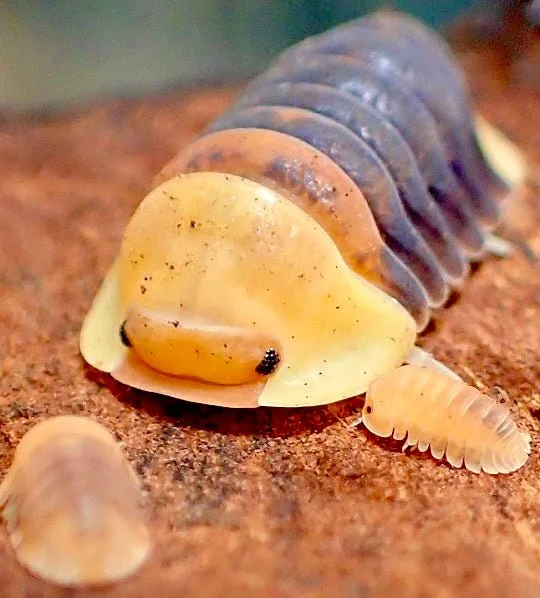
The Rubber Ducky Isopod is one of the most unusual and highly sought-after isopods in the exotic pet hobby. Its rounded body, pale facial markings, and distinctive appearance make it easy to understand why these tiny terrestrial crustaceans have become so popular with collectors and bioactive-terrarium keepers.
 Although they are small, Rubber Ducky Isopods need more thoughtful care than some of the hardier beginner isopod species. These fascinating animals are generally kept as colony pets rather than traditional handling pets.
They spend much of their time under leaf litter, bark, moss, and substrate, becoming more active when the enclosure is dark. With the right environment, a healthy colony can gradually grow and become an interesting miniature ecosystem.
This complete guide covers Rubber Ducky Isopod care, diet, habitat, enclosure setup, humidity, temperature, lifespan, breeding, molting, cleaning, behavior, enrichment, common mistakes, health concerns, cost, and beginner tips.
What Is a Rubber Ducky Isopod?
The Rubber Ducky Isopod is commonly sold in the hobby as Cubaris sp. “Rubber Ducky.” The “sp.” designation is important because the commonly used hobby name does not necessarily represent a formally described species.
These animals belong to the woodlouse group, which is part of the terrestrial isopod family. Despite their insect-like appearance, isopods are actually crustaceans and are more closely related to crabs and shrimp than to insects. Their popularity comes largely from their appearance.
They typically have a dark body combined with lighter facial markings that can create a duck-like expression. They are also fascinating because they perform an important ecological role.
In a natural environment, isopods help break down dead plant material and return nutrients to the soil. In captivity, they can perform a similar function in suitable bioactive enclosures.
However, they should not be considered completely self-cleaning animals. A colony still requires proper feeding, moisture management, ventilation, and routine maintenance.
Rubber Ducky Isopod Facts
Before purchasing a colony, understand the basic husbandry requirements.
| Feature | Details |
| Common Name | Rubber Ducky Isopod |
| Hobby Name | Cubaris sp. “Rubber Ducky” |
| Type | Terrestrial isopod |
| Difficulty | Intermediate |
| Adult Size | Approximately 12–20 mm |
| Typical Lifespan | Around 2–4 years, with variation |
| Temperature | Approximately 72–80°F (22–27°C) |
| Humidity | Generally high, around 70–90% |
| Activity | Mostly nocturnal/crepuscular |
| Diet | Leaf litter, decaying wood, vegetables, supplemental protein |
| Calcium | Essential |
| Substrate | Deep, organic, moisture-retentive |
| Lighting | Normal day/night cycle; UVB is not required |
| Social Behavior | Colony-oriented |
| Handling | Minimal handling recommended |
| Reproduction | Relatively slow compared with prolific species |
These figures should be treated as practical husbandry guidelines rather than rigid rules. Enclosure ventilation, substrate depth, room temperature, colony size, and moisture retention can all affect the ideal conditions.
Rubber Ducky Isopod Origin and Natural Habitat
Rubber Ducky Isopods are associated with Thailand and Southeast Asia, with hobby information often linking Cubaris forms to humid limestone environments.
Their natural environment helps explain their captive-care requirements. Instead of living on exposed, dry ground, these animals are associated with sheltered microhabitats where moisture and organic material are available.
A suitable natural environment can provide:
- Damp soil
- Decaying leaves
- Rotten wood
- Organic debris
- Calcium-rich materials
- Crevices
- Rocks and bark
- Protection from direct sunlight
- Stable humidity
Many Cubaris keepers therefore focus on creating a humid, sheltered enclosure with a deep substrate and plenty of organic material rather than attempting to reproduce an exact geographical location.
The important lesson is simple: stable environmental conditions matter more than decorative accuracy.
Where Do Rubber Ducky Isopods Live in Captivity?
In captivity, Rubber Ducky Isopods are commonly housed in plastic tubs or suitable glass terrariums.
A good enclosure should allow the animals to:
- Burrow
- Hide
- Feed
- Molt safely
- Explore
- Find moisture
- Avoid excessive exposure to light
You may not see the colony constantly.
In fact, disappearing beneath the substrate is normal behavior. This is one reason these animals are best considered observation pets. Their appeal comes from watching natural colony behavior rather than expecting frequent interaction.
Rubber Ducky Isopod Size and Appearance
The adult Rubber Ducky Isopod size is generally around 12–20 mm, although exact measurements can vary between individuals and colonies. Their compact body is protected by a segmented exoskeleton.
The pale facial markings are one of their most recognizable characteristics. Young animals are much smaller and can be surprisingly difficult to spot.
Baby Rubber Duckies may remain deep in the substrate or beneath leaf litter, especially during the early stages of development.
Rubber Ducky Isopod Color and Type Terms
The hobby contains many search terms describing Rubber Ducky Isopods. However, these names should be interpreted carefully.
| Search Term | Meaning or Common Use |
| Rubber Ducky Isopod | General hobby name |
| Ducky Isopods | Short version of the common name |
| Rubber Duckies Isopods | Plural variation |
| Blonde Rubber Ducky Isopod | Usually refers to a lighter-looking animal or line |
| Pink Rubber Ducky Isopod | A term used for pinkish-looking individuals or lines |
| White Rubber Ducky Isopod | A term describing very pale coloration |
| Spiky Rubber Ducky Isopod | Search term describing a particular body appearance |
| Baby Rubber Ducky Isopod | Juvenile Rubber Ducky |
| Rubber Ducky Isopod Types | Usually refers to lines, appearances, or related hobby forms |
| Ducky Isopods for Sale | Commercial search phrase |
A color or trade name should not automatically be treated as a separate scientifically recognized species. When buying unusual varieties, ask the seller for the animal’s exact identification and lineage information.
Rubber Ducky Isopod Enclosure Setup
A properly designed Rubber Ducky Isopod enclosure is one of the most important parts of successful care. The enclosure does not need to be enormous. However, it should provide enough substrate, hiding space, food, and moisture for the colony.
A secure plastic culture tub can work very well because it is lightweight and capable of holding humidity. Glass terrariums are another option when ventilation and moisture can be controlled effectively.
Step-by-Step Enclosure Setup
Step 1: Choose a secure enclosure
Use a container with enough floor area for the colony to grow. Make sure the lid is secure because very small animals and feeder insects can sometimes escape through poorly fitted openings.
Step 2: Add deep substrate
Use a suitable organic substrate that retains moisture without becoming permanently waterlogged. A depth of approximately 3–5 inches is a practical starting point, although deeper setups can also be beneficial.
Step 3: Add rotten hardwood
Decaying hardwood provides food and structure. Avoid wood treated with chemicals, pesticides, paint, or preservatives.
Step 4: Add leaf litter
Leaf litter should form a major part of the colony’s food and shelter system. Add a generous layer rather than a thin scattering.
Step 5: Create a moisture gradient
Keep one portion of the enclosure wetter while allowing another section to remain somewhat less moist. This gives the animals the ability to move toward the conditions they prefer.
Step 6: Add moss
A patch of damp sphagnum moss can provide a useful humid refuge.
Step 7: Add hides
Cork bark, hardwood pieces, and natural crevices create safe hiding areas.
Step 8: Add calcium
Provide an appropriate calcium source for healthy exoskeleton development.
Step 9: Introduce the colony carefully
Once the enclosure is stable, introduce the isopods and allow them time to settle. Do not repeatedly open the enclosure just to check whether every animal is alive.
Rubber Ducky Isopod Substrate
Substrate is not simply bedding. For a colony species, it becomes part of the habitat.
A good substrate should:
- Hold moisture
- Remain aerated
- Contain organic matter
- Support microorganisms
- Allow burrowing
- Avoid becoming swampy
A suitable mix may contain organic soil components, decaying hardwood, leaf material, and other safe natural ingredients.
Avoid substrates containing:
- Fertilizers
- Pesticides
- Artificial fragrances
- Chemical additives
- Fresh manure
- Treated wood
The substrate should smell earthy. A strong rotten or sewage-like smell is a warning sign that something is wrong with moisture, airflow, or decomposition.
Rubber Ducky Isopod Humidity
Humidity is one of the most important factors in Rubber Ducky Isopod care. These animals require a humid environment, but keeping the entire enclosure soaking wet is a mistake.
A practical target is often around 70–90% relative humidity, with a moisture gradient inside the enclosure. Instead of spraying everything repeatedly, focus on maintaining moisture in the substrate.
Signs of insufficient humidity
- Very dry substrate
- Reduced activity
- Animals remaining in one damp area
- Failed or difficult molts
- Slow colony growth
Signs of excessive moisture
- Standing water
- Sour odors
- Poor ventilation
- Persistent wet substrate
- Excessive mold
- Sudden colony losses
The best approach is to provide moisture without stagnation.
Rubber Ducky Isopod Temperature
A stable temperature around 72–80°F (22–27°C) is generally suitable for captive care. Avoid extreme temperatures.
Do not place the enclosure:
- In direct sunlight
- Beside a heater
- Above a radiator
- Directly against a heat vent
- In an area with large temperature swings
If supplemental heating is necessary, use a safe thermostat-controlled system. Increasing temperature simply to speed up breeding is not recommended. Stability should come first.
Rubber Ducky Isopod Diet and Food
The natural feeding behavior of these animals revolves around decomposition. Their diet should therefore be based around leaf litter and decaying wood, with supplemental foods added as needed.
Main food sources
Provide:
- Dried leaves
- Decaying hardwood
- Safe bark
- Commercial isopod food
- Small vegetable portions
- Occasional protein
- Calcium
Leaf litter should always be available. Suitable dried leaves can include pesticide-free leaves from safe tree species. Make sure collected leaves have not been exposed to lawn chemicals, roadside pollution, or pesticides.
Vegetables and fresh foods
Small amounts of vegetables can be offered occasionally.
Options may include:
- Carrot
- Zucchini
- Cucumber
- Pumpkin
- Sweet potato
Fresh food should be offered in moderation. Remove leftovers before they become excessively rotten.
Protein
A colony may benefit from occasional protein-rich food.
Possible options include:
- Dried shrimp
- Fish-based foods
- Shrimp pellets
- Suitable commercial isopod diets
Protein should be supplemental, not a replacement for the natural leaf-litter diet.
Do Rubber Ducky Isopods Need Calcium?
Yes. Calcium is important for maintaining and developing the exoskeleton.
A suitable calcium source can include:
- Cuttlebone
- Crushed limestone
- Oyster shell
- Other appropriate calcium supplements
Keep a modest calcium source available rather than dumping large quantities into the enclosure.
Rubber Ducky Isopod Lifespan
The commonly reported Rubber Ducky Isopod lifespan is around 2–4 years in captivity, although lifespan can vary with genetics and husbandry. Good care can support longevity.
Important factors include:
- Stable moisture
- Suitable temperature
- Proper nutrition
- Calcium
- Successful molts
- Clean but biologically active substrate
- Adequate ventilation
- Low stress
Because they reproduce relatively slowly, don’t judge a colony’s health only by population growth.
Rubber Ducky Isopod Behavior
Rubber Duckies are generally peaceful animals.
Their behavior includes:
- Burrowing
- Foraging
- Hiding
- Exploring
- Molting
- Feeding
- Reproducing
They tend to be more active at night or during low-light conditions. If you place food in the enclosure and see it disappear overnight, that can be a sign that your colony is active even when you rarely see the animals during the day.
Are Rubber Ducky Isopods Good Pets?
Yes, Rubber Ducky Isopods can be excellent pets for the right person. They are especially suitable for people who enjoy small exotic animals and miniature ecosystems.
They are a good choice if you want a pet that:
- Requires little direct interaction
- Can live in a relatively small enclosure
- Is fascinating to observe
- Can be maintained as a colony
- Works well in suitable bioactive setups
However, they are not ideal if you want an animal that enjoys handling.
Advantages
- Unique appearance
- Peaceful temperament
- Quiet
- Low direct-interaction requirements
- Interesting colony behavior
- Suitable for display
- Fascinating breeding process
Disadvantages
- Can be more sensitive than common isopods
- Slow colony growth
- Requires consistent humidity
- Can be expensive
- Often hidden during the day
- Not a handling pet
For a complete beginner, a hardier isopod species may be easier. However, a careful beginner who researches the enclosure requirements can successfully keep Rubber Duckies.
Rubber Ducky Isopod Molting
Molting is a normal and essential part of isopod development. During molting, an isopod sheds its old exoskeleton and develops a new one.
A molting animal may:
- Become less active
- Hide underground
- Remain beneath bark
- Stop moving for periods
- Appear unusually pale
Do not disturb an animal that appears to be molting. The new exoskeleton is temporarily soft, making the animal particularly vulnerable. This is another reason why deep substrate, leaf litter, and hiding spaces are important.
How to Support Healthy Molting
Maintain:
- Appropriate humidity
- Calcium availability
- Good nutrition
- Stable temperature
- Minimal disturbance
Never dig through the enclosure simply to find an animal that has disappeared.
Baby Rubber Ducky Isopods
Baby Rubber Duckies are known as mancae. They are tiny compared with adults and can easily be overlooked. If your colony produces young, avoid making major enclosure changes.
Instead:
- Keep the substrate stable.
- Maintain moisture.
- Keep leaf litter available.
- Provide calcium.
- Offer small amounts of appropriate food.
- Avoid unnecessary handling.
Young isopods benefit from the same stable ecosystem as adults.
Rubber Ducky Isopod Breeding
Breeding is one of the most exciting parts of maintaining a colony. A successful breeding environment requires consistency rather than constant intervention.
Important factors include:
- Stable humidity
- Appropriate temperature
- Deep substrate
- Plenty of leaf litter
- Rotten wood
- Protein
- Calcium
- Hiding places
- Minimal disturbance
The female carries developing young in a specialized brood pouch called a marsupium. Once the young are released, they gradually grow through successive molts.
Why Aren’t My Rubber Ducky Isopods Breeding?
If your colony isn’t producing young, consider:
- Are the animals mature?
- Is the starting colony large enough?
- Is the enclosure stable?
- Is the substrate too dry?
- Is ventilation inadequate?
- Is food consistently available?
- Is calcium available?
- Are you disturbing the colony too often?
Don’t change five variables at once. Make one adjustment and give the colony time to respond.
Rubber Ducky Isopod Cleaning
A healthy colony should not be cleaned like a conventional pet enclosure. The substrate contains microorganisms that contribute to decomposition. Therefore, over-cleaning can actually damage the ecosystem.
Routine maintenance: Check the enclosure regularly for:
- Moisture
- Mold
- Food leftovers
- Bad odors
- Ventilation
- Population activity
- Calcium availability
Remove fresh food when necessary. Add new leaf litter as the old material disappears. Add additional rotten wood when supplies become low.
When Should You Replace Substrate?
Complete substrate replacement should be uncommon. If the enclosure is healthy, allow the ecosystem to mature. A complete change may remove beneficial microorganisms and disturb young animals living deep inside the substrate.
Only consider major substrate replacement when there is a genuine husbandry problem that cannot be corrected through smaller adjustments.
Rubber Ducky Isopod Fun Activities and Enrichment
Isopods don’t need toys like dogs or parrots. Their enrichment comes from environmental complexity.
You can make the enclosure more interesting with:
- Cork bark tunnels
- Leaf-litter layers
- Hardwood pieces
- Moss patches
- Small natural crevices
- Different substrate depths
- Multiple hiding areas
You can also occasionally place a small piece of suitable vegetable in a different location. This encourages natural foraging. The best enrichment is an environment that lets the colony behave naturally.
Rubber Ducky Isopod Price
The Rubber Ducky Isopod price varies considerably.
Factors affecting cost include:
- Colony size
- Availability
- Breeder
- Location
- Shipping requirements
- Lineage
- Demand
- Established versus new colony
They are generally considered specialty isopods and may cost considerably more than common beginner species. If you search for Rubber Ducky Isopods for sale, don’t make price your only consideration.
A responsible seller should be able to explain:
- What animals are being sold
- Their approximate size
- Colony condition
- Feeding practices
- Packing/shipping procedures
- Identification or hobby designation
Be cautious when an unusually cheap listing provides little information.
Rubber Ducky Isopod vs Common Beginner Isopods
Rubber Duckies are not necessarily the easiest choice for someone completely new to the hobby.
| Feature | Rubber Ducky | Dairy Cow | Powder Orange |
| Difficulty | Intermediate | Easy | Easy |
| Reproduction | Relatively slow | Fast | Fast |
| Appearance | Distinctive | Spotted | Orange |
| Humidity | High | Moderate | Moderate |
| Colony Growth | Slower | Fast | Fast |
| Best For | Collectors and patient keepers | Beginners | Beginners |
| Handling | Minimal | Minimal | Minimal |
This doesn’t mean Rubber Duckies are unsuitable for beginners. It simply means they reward careful husbandry and patience.
Common Rubber Ducky Isopod Care Mistakes
Keeping everything soaking wet
High humidity is useful, but stagnant water is not.
Allowing the enclosure to dry completely
A consistently dry substrate can create serious problems.
Using too little leaf litter
Leaf litter should be an important part of the food supply.
Removing old organic material too quickly
Decomposing material is part of the ecosystem.
Overfeeding
Too much fresh food can encourage mold and pests.
Providing no calcium
Calcium should be readily available.
Excessive handling
These are delicate observation animals.
Constantly disturbing the substrate
Young animals and molting individuals may be hidden below the surface.
Overheating
More heat does not automatically mean healthier isopods.
Expecting immediate breeding
Slow colony development can be completely normal.
Rubber Ducky Isopod Troubleshooting
Why are my Rubber Ducky Isopods always hiding?
Hiding is normal. They are secretive animals and often become active after dark. However, if the colony remains inactive even at night, check moisture, temperature, food, and ventilation.
Why aren’t my Rubber Ducky Isopods breeding?
The colony may still be young. Other possibilities include unsuitable moisture, inadequate food, stress, temperature problems, or a small founding group.
Why are my Rubber Ducky Isopods dying?
First, check environmental conditions. Look at:
- Temperature
- Humidity
- Substrate condition
- Ventilation
- Food
- Chemical contamination
- Recent enclosure changes
If several animals die unexpectedly, avoid making rapid changes without identifying the likely cause.
Why is mold growing in my enclosure?
Small amounts of mold can occur naturally in a bioactive environment. However, persistent heavy mold may indicate excess food, poor airflow, or excessive moisture.
Remove excessive food and improve ventilation while maintaining the necessary humidity.
Why are my Rubber Duckies staying in the wet area?
They may be seeking moisture. Check whether the rest of the enclosure is too dry. A proper moisture gradient allows them to regulate their exposure naturally.
Responsible Ownership and EEAT Considerations
Responsible exotic-pet information should distinguish between established scientific facts and hobby observations.
The name Rubber Ducky Isopod is widely used in the hobby, but taxonomy, locality, and individual line information can be more complicated than the common name suggests.
For that reason, keepers should avoid treating every animal sold under a similar trade name as automatically identical.
When purchasing a colony:
- Ask for accurate identification.
- Ask about captive-bred origin.
- Keep records of the colony’s source.
- Research local laws before importing exotic invertebrates.
- Never release captive isopods into the environment.
- Choose responsible breeders where possible.
- Seek professional exotic-animal advice if a serious problem occurs.
Good husbandry is based on observation as well as numbers. A hygrometer can tell you relative humidity, but it cannot tell you whether the substrate is appropriately moist throughout its depth.
Similarly, a temperature reading does not replace observing the colony’s behavior. For this reason, experienced keepers should monitor behavior, feeding, molting, moisture, substrate condition, and population changes together.
FAQs
1. What is the Rubber Ducky Isopod scientific name?
It is commonly known in the hobby as Cubaris sp. “Rubber Ducky.” The “sp.” indicates that the commonly used hobby identification is not necessarily a formally described species name.
2. How big does a Rubber Ducky Isopod get?
Adults are generally around 12–20 mm long, although individual size can vary.
3. What do Rubber Ducky Isopods eat?
Their staple food consists mainly of dried leaf litter and decaying hardwood. Small amounts of vegetables, supplemental protein, and calcium can also be provided.
4. What humidity do Rubber Ducky Isopods need?
They generally prefer high humidity, often around 70–90%, while still requiring adequate ventilation and a moisture gradient.
5. What temperature is best for Rubber Ducky Isopods?
A temperature around 72–80°F (22–27°C) is a practical range for captive colonies.
6. How long do Rubber Ducky Isopods live?
A commonly reported captive lifespan is around 2–4 years, although individual lifespan can vary.
7. Are Rubber Ducky Isopods good pets for beginners?
They can be, but they are better for beginners who are willing to learn about humidity, substrate, feeding, and colony management. Hardier isopods may be easier for a first colony.
8. Do Rubber Ducky Isopods need calcium?
Yes. Calcium supports normal exoskeleton development and molting.
9. Why are Rubber Ducky Isopods so expensive?
Their specialty status, demand, slower reproduction, and availability can make them considerably more expensive than common isopod species.
10. Can Rubber Ducky Isopods be handled?
Minimal handling is recommended. They are delicate and are better enjoyed as observation animals.
Final Thoughts
The Rubber Ducky Isopod is a remarkable little animal for keepers who enjoy unusual pets, miniature ecosystems, and naturalistic terrariums. Its distinctive appearance makes it one of the most recognizable isopods in the hobby, but appearance is only part of its appeal.
The real enjoyment comes from watching a colony establish itself. You may initially see only a few animals. Then, as the enclosure matures, you may notice feeding activity, tiny mancae, fresh molts, and increasingly complex interactions with the leaf litter and substrate.
Successful Rubber Ducky Isopod care is therefore less about constant intervention and more about creating the right environment and maintaining it consistently.
Focus on:
- Deep organic substrate
- Plenty of leaf litter
- Decaying hardwood
- High but controlled humidity
- Good ventilation
- Appropriate temperature
- Calcium
- Balanced supplemental food
- Safe hiding places
- Minimal disturbance
Most importantly, be patient.
A Rubber Ducky colony may not grow as quickly as some beginner isopods, but that slower pace is part of the experience. When properly maintained, these tiny crustaceans can become an engaging and rewarding exotic pet colony that provides something very different from traditional companion animals.
I’ve created helpful guides in the Birds category on Petstdigo, featuring posts in Care, Cleaning, and Fun Activities. These guides share practical tips on grooming, skin and coat health, bathing routines, nutrition, playtime ideas, and calming solutions to keep your pets happy and healthy. Explore these pages for easy-to-follow advice and insights to support your pet’s overall well-being.