
If you are looking for a unique reptile that is fascinating to watch and different from the typical pet lizard, the Uromastyx is worth learning about. These sturdy desert lizards are known for their thick bodies, spiny tails, calm personalities, and plant-based diet.
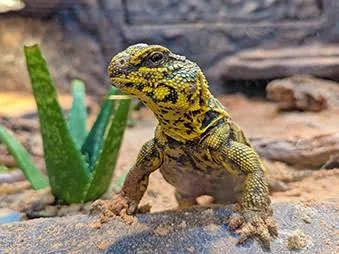 However, keeping one healthy requires more than simply providing a tank, heat lamp, and vegetables. Good Uromastyx care depends on getting several things right at the same time.
Your pet needs a spacious enclosure, powerful UVB lighting, a hot basking area, suitable temperatures, a dry environment, hiding places, and a carefully planned Uromastyx diet.
Fortunately, once the habitat is established correctly, daily care can become quite manageable.
This guide explains everything beginners should know about the Uromastyx lizard, including its natural habitat, size, lifespan, enclosure setup, feeding, handling, cleaning, enrichment, common health problems, and responsible ownership.
Uromastyx Facts
Before getting into the details, here are the most important facts to remember.
| Feature | Details |
| Common name | Uromastyx, Spiny-tailed Lizard, Mastigure |
| Diet | Primarily herbivorous |
| Adult size | Approximately 9–30 inches depending on species |
| Lifespan | Often 15–20+ years with proper care |
| Activity | Mainly diurnal |
| Basking temperature | Around 120–130°F depending on species and setup |
| Cool-side temperature | Around 80–90°F |
| Humidity | Generally low, species-dependent |
| UVB | Strong UVB is essential |
| Enclosure | Large, secure, well-ventilated |
| Social housing | Usually best kept individually |
| Difficulty | Intermediate |
| Best for | Keepers prepared for long-term reptile care |
These are general guidelines rather than universal numbers. Different Uromastyx species have somewhat different requirements, so always adjust husbandry according to the species you keep.
What Is a Uromastyx Lizard?
A Uromastyx lizard is a desert-dwelling reptile belonging to the genus Uromastyx. The name is associated with their distinctive spiny tail, which is one of their most recognizable features.
Unlike many popular pet lizards, Uromastyx are primarily plant eaters. They spend much of the day basking, exploring, eating vegetation, and moving between warm and cooler areas.
Their powerful bodies and spiked tails are adaptations for surviving harsh environments. When threatened, a Uromastyx can use its tail defensively, which is one reason these lizards should be handled calmly and respectfully.
Although they can become comfortable around their keeper, they are not generally pets that need constant handling. Their appeal comes from observing their natural behaviors and providing an interesting environment where they can thrive.
Where Do Uromastyx Live Naturally?
Wild Uromastyx lizards occur across parts of North Africa and the Middle East. Their range includes deserts, rocky landscapes, sandy regions, and other areas where temperatures can become extremely high during the day.
The exact environment depends on the species. For example, an Uromastyx aegyptia may inhabit extremely desert environments, while other species occupy rocky or more varied habitats. These lizards are built for intense sunlight and heat.
Their natural environment is therefore very different from a cool, humid tropical reptile enclosure. That difference is important for beginners. You should not set up a Uromastyx enclosure like a generic reptile tank.
Instead, think about creating a warm, bright, dry environment with plenty of opportunities for basking, hiding, climbing, and digging.
Natural Uromastyx Habitat
A natural Uromastyx habitat usually includes several useful features:
- Strong sunlight
- Hot basking surfaces
- Rocky areas
- Sandy or sandy-soil ground
- Burrows and crevices
- Dry vegetation
- Open areas for movement
- Sheltered hiding places
Uromastyx can spend considerable time inside burrows or shelters when they need protection from extreme heat or predators. Therefore, a good captive enclosure should not be empty.
Instead, provide a basking zone, a cooler retreat, sturdy hides, rocks or ledges, and appropriate substrate. This allows your pet to make choices throughout the day.
Types of Uromastyx
There are numerous recognized species and taxonomic groups within the genus. Common names used in the pet trade can also vary, so buyers should pay attention to the scientific name rather than relying only on a color or market name.
| Type | Scientific Name | General Characteristics |
| Egyptian | Uromastyx aegyptia | One of the largest and most impressive species |
| Ornate | Uromastyx ornata | Attractive markings and strong coloration |
| Ocellated | Uromastyx ocellata | Known for distinctive patterning |
| Mali | Uromastyx dispar | Popular captive species with attractive coloration |
| Moroccan | Often associated with U. acanthinura | Variable coloration and robust body |
| Saharan | Commonly associated with Saharan species/groups | Adapted to very dry environments |
| Thomas’s | Uromastyx thomasi | Smaller species from the Arabian Peninsula |
| Yemeni | Uromastyx yemenensis | Species with somewhat different environmental requirements |
| Yellow Uromastyx | Trade/common name | Often refers to yellow or golden individuals rather than one universal species. |
| Red Uromastyx | Trade/common name | Usually describes coloration rather than a separate species |
Names such as yellow Uromastyx, red Uromastyx, and Moroccan Uromastyx can be used differently by sellers. Consequently, always confirm the animal’s scientific identification and locality when possible.
Uromastyx Size
One of the biggest differences between species is Uromastyx size.
Some remain relatively small, while others become very large and heavy-bodied. In general, the genus can range from roughly 9 inches to around 30 inches in total length, although individual species differ considerably.
The Egyptian Uromastyx’s size is particularly important for beginners because Uromastyx aegyptia can become much larger than some of the smaller species. A small juvenile may initially look comfortable in a modest enclosure.
However, it will grow. Therefore, plan the adult enclosure before purchasing your lizard rather than choosing equipment based only on its current size.
Uromastyx Enclosure Setup
A proper Uromastyx enclosure is one of the most important parts of successful husbandry. For smaller and medium-sized species, a large enclosure around 4 feet long by 2 feet wide by 2 feet high is often used as a starting point.
Larger species, especially Egyptian Uromastyx, can require an enclosure around 8 feet by 4 feet by 4 feet or even larger. Bigger is generally better when you can safely provide appropriate heating and lighting.
What Should Be Inside the Enclosure?
A well-designed enclosure should include:
- A hot basking area
- A cooler area
- At least one secure hide
- Additional shaded retreats
- Sturdy rocks or ledges
- Appropriate substrate
- Food dish
- Optional shallow water dish
- Strong UVB lighting
- Safe climbing structures
- Natural-looking enrichment
The enclosure should also be escape-proof. Uromastyx are powerful reptiles, and a weak screen, loose door, or unstable decoration can become a problem.
Substrate
A naturalistic sandy or sandy-soil substrate can work well when the animal is healthy, and the enclosure is properly managed.
A sufficiently deep substrate also allows natural digging and burrowing behavior. However, substrate selection should be reconsidered if the lizard is sick, injured, dehydrated, or being treated for a medical condition.
In those situations, a simpler temporary substrate may make monitoring and hygiene easier.
Uromastyx Temperature and Heating
Heat is essential for a healthy Uromastyx. The basking surface generally needs to reach approximately 120–130°F (49–55°C), while the opposite side should remain significantly cooler.
The goal is not to make the entire enclosure extremely hot. Instead, create a thermal gradient. Your Uromastyx should be able to move closer to the heat when it needs to warm up and retreat to a cooler area when it becomes too warm.
Example Temperature Zones
| Area | Approximate Temperature |
| Basking surface | 120–130°F |
| Warm area | Around 90–100°F |
| Cool area | Around 80–90°F |
| Night | Cooler than daytime, while avoiding unsafe cold |
Exact temperatures should be adjusted for species, enclosure design, room temperature, and measurements.
Use reliable digital thermometers and, where appropriate, an infrared temperature gun to check actual surface temperatures.
Never judge basking temperature simply by touching a rock.
UVB Lighting for Uromastyx
Strong UVB lighting is essential. In nature, these desert reptiles experience intense sunlight. In captivity, the lighting system must therefore provide an appropriate UVB exposure.
A quality linear T5 HO UVB fixture is commonly used for larger reptile enclosures. The exact UVB strength and distance depend on the fixture, reflector, mesh, enclosure height, and basking location.
UVB is important because it supports vitamin D3 production and calcium metabolism. Without appropriate UVB, diet alone cannot guarantee proper calcium utilization.
Replace UVB bulbs according to the manufacturer’s recommended schedule rather than waiting until the bulb visibly stops producing light.
Humidity for Uromastyx
Uromastyx generally prefer a dry environment, but humidity requirements are species-specific. Many commonly kept species do well with relatively low ambient humidity, while certain species may naturally experience somewhat higher humidity.
Good ventilation is therefore essential. Avoid keeping the entire enclosure constantly damp. At the same time, do not assume that “desert reptile” means humidity should be ignored completely.
Species, nighttime conditions, ventilation, substrate, and the animal’s health all matter.
Uromastyx Diet and Feeding
The Uromastyx diet is one of the most important differences between these lizards and many other commonly kept reptiles.
They are primarily herbivorous. A healthy diet should therefore be built around suitable plant foods rather than insects or animal protein.
What Food Is Good for Uromastyx?
Suitable foods can include:
- Collard greens
- Mustard greens
- Turnip greens
- Dandelion greens
- Endive
- Escarole
- Arugula
- Cactus pads
- Hibiscus flowers
- Dandelion flowers
- Squash
- Zucchini
- Green bean
- Appropriate lentils
- Small amounts of suitable seeds
Variety is important. Rather than feeding the same vegetable every day, rotate appropriate greens and vegetables.
Feeding Uromastyx
Feeding Uromastyx is generally straightforward once you understand the basic diet. Juveniles typically need food more frequently than adults because they are growing rapidly.
Adults can generally be fed several times per week rather than being forced onto a heavy daily feeding schedule.
Fresh greens should be clean and appropriately prepared. Remove uneaten fresh food before it begins to spoil.
Uromastyx Feeding Schedule
A general approach may look like this:
| Age | General Feeding Pattern |
| Juvenile | Frequent feeding, often daily |
| Young adult | Several meals per week |
| Adult | Around 4–5 feeding days per week, depending on condition and diet |
Individual needs can vary.
A growing animal may require more food than an overweight adult, while breeding animals may have different nutritional needs.
Food for Uromastyx to Avoid
Not every vegetable or human food is suitable.
Avoid making the diet heavily dependent on:
- High-sugar fruits
- Processed foods
- Salty foods
- Bread and baked goods
- Dairy products
- Meat-based foods
- Toxic plants
- Foods treated with pesticides
- Large amounts of high-oxalate foods
Fruit should generally be rare rather than a routine part of the diet. Also, do not assume that because a food is safe for another herbivorous reptile, it is automatically appropriate for Uromastyx.
What About Insects?
Because Uromastyx are primarily herbivorous, insects should not become a regular source of nutrition. Their diet should remain centered on appropriate plant foods. If you are unsure about a particular food, it is better to leave it out until you can verify that it is suitable for your species.
Calcium and Supplements
Calcium is important for proper bone development and muscle function. However, supplementation should complement a properly balanced diet rather than compensate for poor husbandry.
Use an appropriate reptile calcium supplement according to veterinary or product guidance. Most importantly, calcium cannot replace UVB.
A lizard receiving calcium but lacking proper UVB and appropriate heat can still develop serious health problems.
Water and Hydration
Uromastyx obtain considerable moisture from their food.
However, providing access to clean, fresh water can still be useful depending on the species and individual setup. If you provide a water dish, keep it shallow, stable, and clean.
You should also monitor hydration through behavior, appearance, urates, appetite, and overall condition. A dehydrated or weak lizard should be assessed by a qualified reptile veterinarian rather than treated only by changing the water setup.
Uromastyx Lifespan
The Uromastyx lifespan can be surprisingly long. With appropriate care, many individuals can live 15–20 years or more, although lifespan varies by species, genetics, husbandry, nutrition, and veterinary care.
That means buying a Uromastyx is a long-term commitment. A healthy juvenile today could still be part of your household many years from now.
Before buying one, consider whether you can provide proper enclosure space, heating, UVB, food, and veterinary care for the animal’s entire life.
Is a Uromastyx a Good Pet?
For the right keeper, absolutely. Uromastyx can be fascinating pets because they are:
- Intelligent and observant
- Visually striking
- Active during daylight
- Interesting to watch
- Long-lived
- Primarily herbivorous
- Capable of becoming comfortable around their keeper
However, they are not ideal for everyone. They require specialized lighting, high basking temperatures, considerable enclosure space, and a carefully managed diet.
Therefore, they are better suited to someone willing to learn reptile husbandry rather than someone looking for a low-maintenance pet.
Uromastyx Temperament and Handling
Many captive Uromastyx can become relatively calm with consistent, gentle interaction.
However, temperament varies between individuals. A new lizard should not be immediately handled for long periods. Instead, allow it to settle into its enclosure first. Then gradually build trust.
Safe Handling Tips
- Approach slowly.
- Avoid grabbing from above.
- Support the entire body.
- Keep the tail supported when necessary.
- Never pull or bend the tail.
- Keep handling sessions short initially.
- Watch for stress signals.
- Return the lizard to its enclosure if it becomes agitated.
Remember that a Uromastyx’s tail is an important defensive tool. Respecting its body language will make handling safer for both you and the animal.
Fun Activities and Enrichment
A Uromastyx does not need toys in the same way a dog does. Instead, enrichment should encourage natural behaviors.
You can create an interesting environment with:
- Multiple hides
- Cork bark
- Flat rocks
- Safe climbing structures
- Digging areas
- Ledges
- Different textures
- Drought-tolerant plants
- Rearranged non-hazardous enclosure features
Food enrichment can also be useful. For example, instead of placing every piece of food in one pile, you can safely distribute suitable greens around different areas of the enclosure.
This encourages exploration and foraging. However, always make sure decorations are stable enough that they cannot fall and injure the animal.
Cleaning a Uromastyx Enclosure
A clean enclosure reduces odors and helps you monitor your pet’s health.
Daily Tasks
- Remove feces.
- Remove spoiled food.
- Replace contaminated substrate when necessary.
- Check water if a dish is provided.
- Observe appetite and activity.
Weekly Tasks
- Clean food dishes.
- Inspect hides.
- Check enclosure equipment.
- Look for mold or excessive moisture.
- Inspect substrate condition.
Deeper Cleaning
The exact schedule depends on the enclosure type and substrate. Naturalistic systems may require different maintenance from simple setups.
Regardless of the method, avoid using harsh chemicals around the animal unless they are specifically appropriate for reptile enclosures and thoroughly rinsed as directed.
Common Uromastyx Health Problems
Even excellent husbandry cannot eliminate every health problem. Some conditions associated with captive reptiles include:
Metabolic Bone Disease
Poor calcium intake, inadequate UVB, and improper husbandry can contribute to metabolic bone disease.
Possible warning signs include:
- Weakness
- Tremors
- Soft or abnormal bones
- Difficulty walking
- Swollen limbs
- Poor growth
Dehydration
Signs can include lethargy, poor appetite, abnormal urates, and reduced activity.
Respiratory Problems
Difficulty breathing, nasal discharge, open-mouth breathing, or unusual respiratory sounds require veterinary attention.
Gout and Kidney Problems
Improper nutrition and dehydration can contribute to serious internal problems.
Impaction
Substrate ingestion, dehydration, and inappropriate husbandry may contribute to digestive obstruction.
If your Uromastyx stops eating, becomes unusually weak, develops swelling, has difficulty breathing, or shows a major behavior change, contact an experienced reptile veterinarian.
Common Beginner Mistakes
Many Uromastyx problems come from avoidable husbandry mistakes.
1. Using an enclosure that is too small
A juvenile may look comfortable in a small tank, but adults need substantially more room.
2. Weak UVB
A normal household bulb is not a replacement for appropriate UVB.
3. Making the entire enclosure equally hot
Your pet needs a temperature gradient.
4. Feeding too much food
Overfeeding can contribute to obesity.
5. Offering an inappropriate diet
A Uromastyx should not be fed like an insect-eating lizard.
6. Keeping multiple animals together without experience
Cohabitation can lead to stress, competition, and injury.
7. Ignoring species differences
An Uromastyx aegyptia does not have the same space requirements as a smaller species.
8. Buying based only on appearance
A beautiful red Uromastyx, yellow Uromastyx, or ornate Uromastyx may look appealing, but health and proper identification are more important than color.
How Much Does a Uromastyx Cost?
The purchase price varies considerably depending on species, age, coloration, captive-bred status, breeder reputation, and availability. However, the animal itself is only part of the cost.
You also need to budget for:
- Large enclosure
- UVB fixture and bulbs
- Heating equipment
- Thermostats
- Thermometers
- Substrate
- Hides
- Food
- Supplements
- Cleaning supplies
- Veterinary care
So don’t search only for the cheapest Uromastyx for sale. A low purchase price does not necessarily mean a lower total cost of ownership.
Buying a Uromastyx Responsibly
If you are searching for an Uromastyx for sale, take time to evaluate the source.
A responsible seller should be willing to provide information about:
- Species identification
- Approximate age
- Captive-bred status
- Feeding history
- General health
- Origin or locality when known
- Current diet
- Any known health concerns
Look for an alert animal with clear eyes, normal movement, a healthy body condition, and no obvious discharge or wounds. Be especially cautious with unusually cheap animals or sellers who cannot answer basic husbandry questions.
The same applies when searching for an ornate Uromastyx for sale or Egyptian Uromastyx for sale. Correct identification and health should come before appearance.
Also check your local wildlife and exotic-animal regulations before purchasing. Rules concerning ownership, importation, transportation, and trade can vary by country, state, or locality.
Expert Care and Responsible Ownership
Good Uromastyx husbandry is built around evidence-based reptile care rather than a single setup copied from another keeper.
Species identification matters because enclosure size, humidity, diet, and environmental preferences can differ. Likewise, equipment should be measured rather than guessed.
Use reliable temperature instruments, provide appropriate UVB, and monitor your animal’s body condition over time.
Most importantly, establish a relationship with a veterinarian who is experienced with reptiles before an emergency happens. This guide is intended for educational purposes and does not replace professional veterinary diagnosis or treatment.
FAQs
1. How big does a Uromastyx get?
Uromastyx size depends heavily on species. Some species remain under a foot long, while larger species can approach 30 inches. Egyptian Uromastyx are among the larger commonly discussed species.
2. How long does a Uromastyx live?
A well-cared-for Uromastyx can commonly live 15–20 years or longer, depending on species and individual health.
3. What do Uromastyx eat?
Uromastyx are primarily herbivorous and should receive a varied diet of suitable leafy greens, vegetables, flowers, and other appropriate plant foods.
4. Do Uromastyx need UVB?
Yes. Appropriate UVB exposure is an important part of successful Uromastyx care and calcium metabolism.
5. How hot should a Uromastyxs basking spot be?
A basking surface around 120–130°F is commonly recommended, although the exact target should be adjusted according to species and equipment.
6. Are Uromastyxs good beginner reptiles?
They can be good pets for prepared beginners, but they are not the easiest reptile because they require strong UVB, high basking temperatures, a large enclosure, and specialized dietary care.
7. Can Uromastyxs eat insects?
Uromastyx are primarily herbivorous, so insects should not be a regular staple.
8. Can Uromastyxs live together?
Some experienced keepers may attempt group housing in suitable circumstances, but individual housing is generally simpler and reduces the risk of territorial conflict and competition.
9. Is an Egyptian Uromastyx a good pet?
An Egyptian Uromastyx can be an impressive pet, but its large adult size means it requires significantly more space and resources than smaller Uromastyx species.
10. Are Uromastyx expensive to keep?
The ongoing food cost can be manageable because their diet is plant-based, but the initial setup can be expensive because they need a large enclosure, powerful lighting, heating equipment, and appropriate environmental control.
Final Thoughts
The Uromastyx is an impressive desert reptile that can make a rewarding long-term pet when its needs are understood.
Its care is centered around a few fundamentals: a large enclosure, strong UVB, intense basking heat, appropriate temperature gradients, a dry and well-ventilated environment, and a nutritious plant-based diet. At first, the setup may seem complicated.
However, once the enclosure is correctly established, daily care becomes much easier. The most important thing is to choose the species carefully and plan for its adult requirements from the beginning.
Whether you are interested in an ornate Uromastyx, Mali Uromastyx, Egyptian Uromastyx, ocellated Uromastyx, or another species, responsible ownership starts with accurate identification and proper husbandry.
A Uromastyx is not simply a desert lizard that needs heat. It is a long-lived animal with specific environmental and nutritional requirements.
Give it the right habitat, provide a carefully balanced diet, monitor its health, and respect its natural behaviors. In return, you can enjoy one of the most unusual and fascinating pet lizards available to experienced reptile keepers.
I’ve created helpful guides in the Birds category on Petstdigo, featuring posts in Care, Cleaning, and Fun Activities. These guides share practical tips on grooming, skin and coat health, bathing routines, nutrition, playtime ideas, and calming solutions to keep your pets happy and healthy. Explore these pages for easy-to-follow advice and insights to support your pet’s overall well-being.